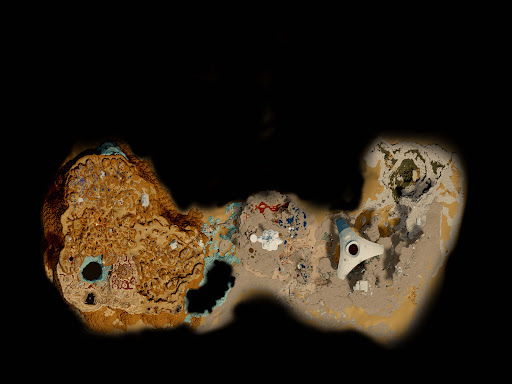
Titan Rockbore Guide

Normal Fauna
Passive
Sessile
・Shallows
・Blighted Coral
・Observatory
・Power Plant
Titan Rockbore Behavior
These are found at the base of Angel Comb, which they are in a symbiotic relationship with.

Titan Rockbore Databank Entry
This enormous colony organism (Lithodont titanicae) resembles a spinal cord protected by a thick crablike shell. It extends beyond scanner range in both directions, growing through fractures in the seabed rock.
[1] Hollow interior
The interior of the bore contains at least two large flooded channels - one strikingly radioactive. The ancestral form may be a pyrosome (a sea squirt).
[2] Poor health
Most of the zooids in the bore are dead, leaving only a mineral skeleton and a hydrocarbon-polymer shell. The interior channels have clogged.
[3] Unknown metabolism
The bore has no apparent food supply. It may have derived chemical energy from minerals, but if so, its bacterial symbiotes have fled. It is starving.
[4] Viral activity
The surviving tissue is infected with large RNA virus similar to Earthly giant sea viruses. The bore's anatomy includes receptor sites that encourage viral infection and reproduction. Further analysis required.
Assessment: Entirely unknown organism - investigate further, determine origin and ecological niche.
Titan Rockbore Survival Tips
They can look like roots of the Angel Comb. When you see infected Angel Comb, follow the 'roots' to find the Bloom Canckers or Bloom Nodes.